Jura 12, an accessible island worth the detour
Isolation is normally exactly what a whisky brand turns into a premium, and Jura has as much of it as anywhere in Scotland: one single-track road, one village, one distillery, a ferry from Islay. It never really charged for any of it, and the reason sits in the distillery's own history — rebuilt around 1960 with a blender's money, to make a light spirit designed to disappear into blends. Both of our valuation models now land in almost the same place, essentially fair value, which makes the twelve-year-old one of the few genuinely accessible ways into island single malt.
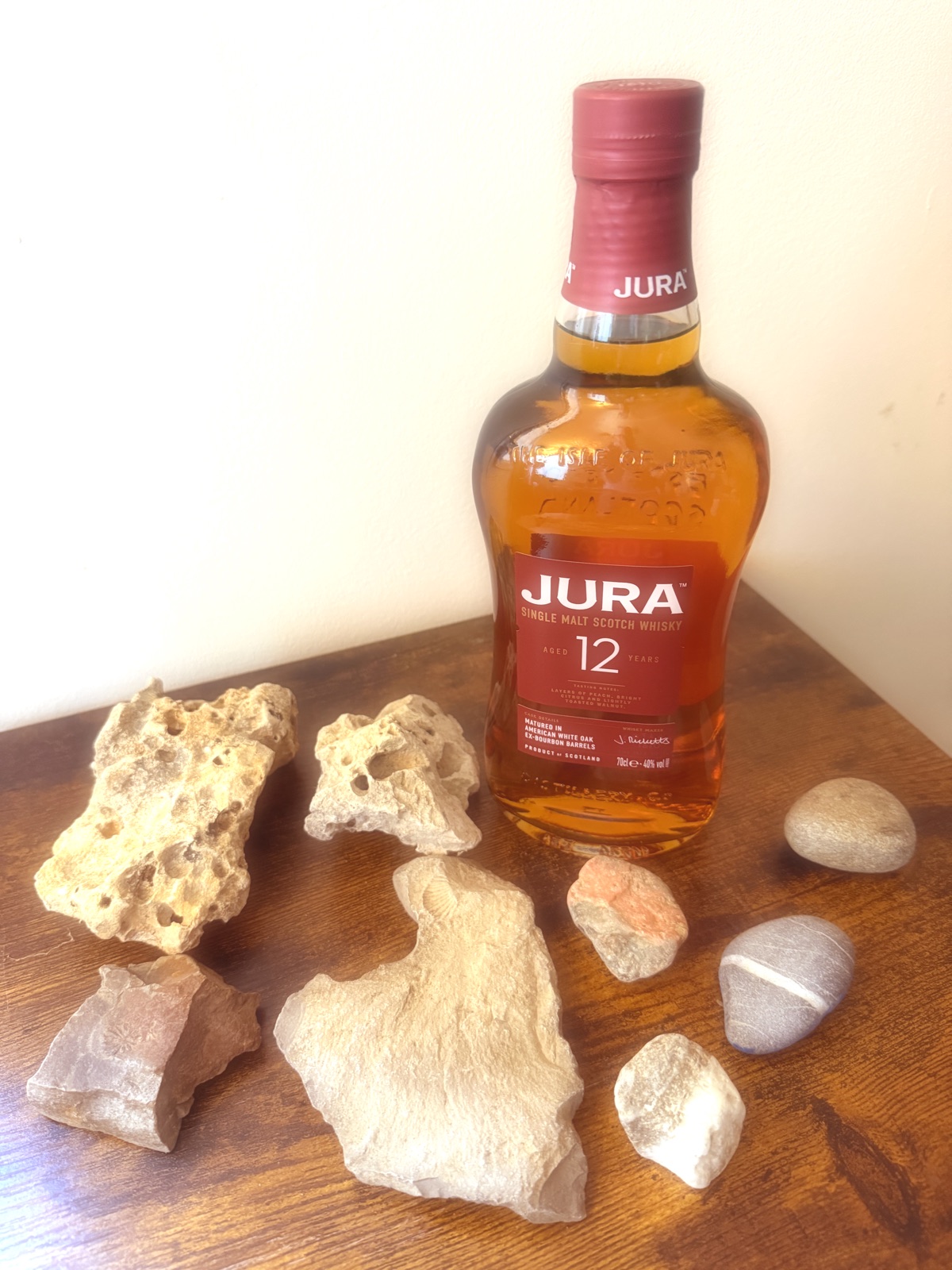
Jura’s whole identity is built around remoteness: one single-track road, one village, one distillery, and a ferry connection from Islay. Normally, that kind of isolation is exactly the sort of thing a whisky brand turns into a premium. Jura never really has.
There is a historical reason for that. When two island landowners revived the distillery around 1960, partly in an effort to stem the island’s depopulation, the backing came from the blending house Charles Mackinlay & Co. William Delmé-Evans designed the new distillery around unusually tall, 25-foot stills, producing a light, Highland-style spirit deliberately different from the heavily peated malts being made just across the water on Islay. Jura was, in other words, built to make whisky that worked well in blends. And a malt designed to blend in rather than stand out has a harder time developing the distinctive signature that commands a premium as a single malt. Jura has a great story; it just never managed to turn that story into price.
What makes the bottle interesting analytically is that, unusually, both valuation models come to almost the same conclusion. The relative-value model puts Jura 12 above its shelf price, and the fundamental build-up does much the same. Most of the value comes simply from twelve years of maturation. Plain ex-bourbon oak, bottling at 40%, and a reputation that is solid rather than exceptional don’t add much of a premium beyond that. The live panel below comes out at essentially fair value.
That makes an interesting contrast with Talisker 10, where the two models disagree quite sharply. And in some ways that is the more useful comparison: divergence is where the arguments begin; convergence is what an unstoried price looks like.
There is also a nice final irony in the name. Our photograph brings together two very different Juras: the French Jura, whose limestone mountains gave their name to the Jurassic period, and the Hebridean Isle of Jura, whose ancient quartzite is roughly 600 million years old and contains no fossils at all.